
As a dental employer, OSHA compliance under the Hazard Communication Standard (HazCom) is a critical part of maintaining a safe clinical environment. Dental offices routinely handle chemical products such as disinfectants, sterilants, impression materials, and anesthetics—many of which require Safety Data Sheets (SDSs).
While OSHA’s requirements are clearly defined, SDS update rules often create confusion, particularly around what qualifies as “significant information” and how frequently SDSs must be revised in a dental setting.
Understanding SDS update requirements helps dental practices stay compliant, reduce regulatory risk, and ensure staff and patient safety.
Why SDS Compliance Matters in Dental Offices
Dental practices are considered employers under OSHA regulations and are required to maintain a Safety Data Sheet for every hazardous chemical used in the office.
SDSs are essential because they provide:
- Hazard and exposure information for dental materials
- First aid and emergency response instructions
- Allergy and sensitization risks for staff and patients
- Safe handling and storage guidance
Non-compliance can also result in financial penalties. As of 2024, OSHA fines for other-than-serious violations can exceed $16,000 per violation, depending on severity and circumstances.
How Often Should Dental Safety Data Sheets Be Updated?
Under the Hazard Communication Standard (29 CFR 1910.1200), there is no fixed schedule for updating Safety Data Sheets.
Instead, SDS updates are required whenever new and significant hazard information becomes available.
This includes changes such as:
- New hazard classifications
- Updated exposure limits
- New risk mitigation or protective measures
- Revised chemical composition or formulation
- Newly identified health or safety risks
In a dental setting, this means SDSs must be updated whenever manufacturers revise product information—not on a set annual cycle.

When Must Suppliers Provide Updated SDSs?
OSHA requires chemical manufacturers and importers to provide updated SDSs:
- At the time of the first shipment
- With the next shipment after an SDS has been updated with significant new hazard information
Importantly, there is no requirement for manufacturers to proactively resend SDSs to all previous customers unless additional shipments occur.
This makes it critical for dental offices to actively maintain SDS access rather than relying solely on supplier distribution.
When Must an SDS Be Updated by Manufacturers?
According to OSHA, SDS preparers must ensure information accurately reflects current scientific evidence.
If new significant hazard information becomes available, the SDS must be updated within three months.
This includes updates related to:
- Hazard reclassification
- New exposure controls or safety measures
- Scientific or regulatory findings affecting chemical safety
What Counts as a “Significant Change” in Dental SDSs?
In dental environments, “significant changes” that trigger SDS updates typically include:
- Changes in disinfectant or sterilant formulation
- Updated toxicity or exposure data for dental materials
- New labeling requirements for chemical products
- Revised inhalation or skin exposure risks
- Updated regulatory classifications under GHS or OSHA
Even small formulation changes in dental chemicals can impact SDS accuracy and compliance obligations.
Common SDS Challenges in Dental Practices
Dental offices often face unique SDS management challenges, including:
- Managing SDSs across multiple treatment rooms
- Tracking updates from multiple chemical suppliers
- Maintaining paper binder systems that become outdated quickly
- Lack of centralized SDS access during inspections
- Difficulty confirming SDS version accuracy across staff
These challenges increase compliance risk during OSHA inspections.
Moving Beyond SDS Binders in Dental Offices
Many dental practices still rely on physical SDS binders, which can become difficult to maintain and update in real time.
Modern dental offices are increasingly transitioning to digital SDS management systems to:
- Centralize all chemical documentation
- Ensure real-time access to updated SDSs
- Reduce manual tracking and administrative burden
- Improve OSHA inspection readiness
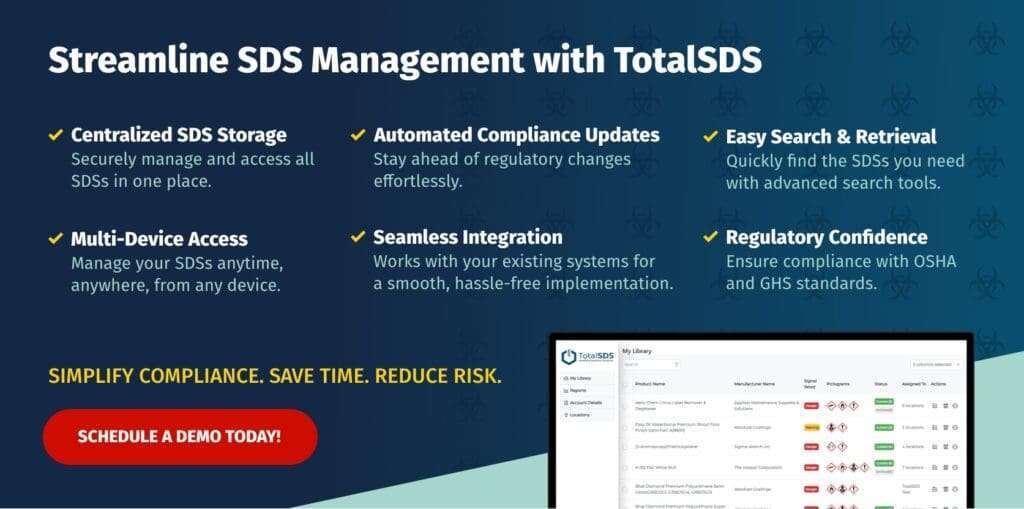
Solutions such as the TotalSDS SDS Manager platform allow dental practices to maintain a compliant, always-updated SDS library accessible across devices and locations.
How SDS Software Supports Dental Compliance
For dental organizations managing multiple chemicals and vendors, SDS software helps simplify compliance by:
- Automatically updating SDS versions when new data is released
- Centralizing chemical inventories across the practice
- Ensuring staff can instantly access SDSs during emergencies
- Reducing reliance on manual binder updates
- Supporting OSHA HazCom documentation requirements
When combined with structured authoring tools like TotalSDS Authoring, organizations can also ensure consistency when generating or updating chemical documentation.